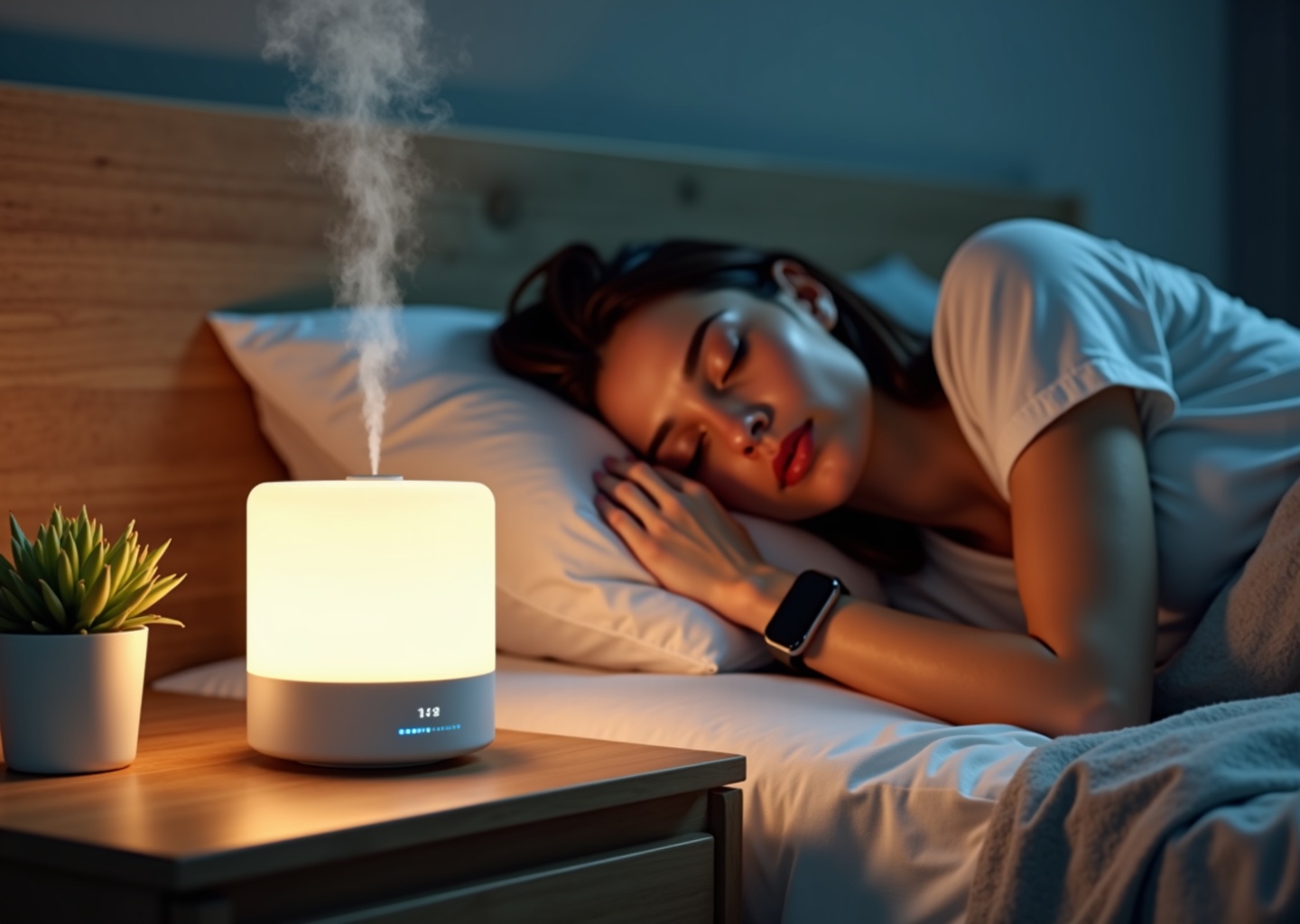
Dry air sabotages sleep by irritating airways and causing snoring. This guide explores the best humidifiers for sleep in 2025, focusing on models that are whisper‑quiet and easy to clean. You’ll learn what features matter, how to maintain devices safely, and which options suit different bedrooms and sleep needs to improve rest without extra hassle.
Why humidifiers help sleep and what the science says
Waking up with a scratchy throat or a stuffy nose is a common problem, especially when the heat or air conditioning is running constantly. The culprit is often the dry air in your bedroom, which can silently sabotage your rest. Adding moisture back into the air with a humidifier can make a real difference in your sleep quality, and the science explains why our bodies respond so well to this simple change.
Sleep clinics and health experts generally agree on an ideal humidity level for the bedroom. They recommend maintaining a relative humidity between 40 and 50 percent. This range is considered the sweet spot for respiratory comfort and health. When indoor air is too dry, typically below 30 percent humidity, it acts like a sponge, pulling moisture from wherever it can, including your body. This process dries out the delicate mucous membranes that line your nasal passages, throat, and airways. The result is irritation, inflammation, and congestion that can lead to coughing, throat clearing, or a feeling of stuffiness that disrupts sleep.
By maintaining humidity in that optimal 40 to 50 percent zone, a humidifier helps keep these tissues properly hydrated. This has several direct benefits for sleep.
- Soothed Airways. Hydrated airways are less prone to irritation from dust, allergens, or simply the friction of air passing through. This reduces the likelihood that a tickle in your throat or a bout of coughing will wake you up.
- Easier Nasal Breathing. Proper humidity helps thin mucus and reduce swelling in the nasal passages. This makes it easier to breathe through your nose, which is more efficient and restful than mouth breathing.
- Reduced Snoring. For some people, snoring is caused or worsened by mouth breathing due to congestion. By promoting clearer nasal passages, a humidifier can help reduce the vibrations in the throat that cause snoring, leading to a quieter night for you and your partner.
Humidity also works hand in hand with temperature to influence your sense of comfort. Dry air can make a room feel colder than the thermostat reading, prompting you to bundle up in blankets that might make you too hot later. According to sleep medicine guidance, air with balanced moisture feels warmer and more comfortable. This improved thermal comfort helps your body relax, which can make it easier to fall asleep and stay in deeper, more restorative sleep stages.
However, more is not always better. Pushing humidity levels above 60 percent can create a new set of problems that are just as harmful to sleep. You might notice condensation on your windows, a clear sign that the air is too damp. This excess moisture creates a perfect breeding ground for mold and mildew on walls, windowsills, and other surfaces. These fungi release spores into the air that can trigger allergies and respiratory issues, completely undermining the goal of healthier sleep.
High humidity is also an open invitation for dust mites. Peer-reviewed studies confirm that these microscopic allergens, a major trigger for allergy and asthma sufferers, thrive and multiply rapidly when humidity climbs above 50 percent. An over-humidified room can quickly become an environment that promotes sneezing, wheezing, and itchy eyes, leading to a fragmented and miserable night.
The goal, then, is to consistently maintain that 40 to 50 percent humidity level to support your body’s natural sleep processes without creating an unhealthy indoor environment. This brings up two critical, practical challenges for any humidifier used in the bedroom. The device itself must not introduce new sleep disruptions, like humming, gurgling, or buzzing. And it must be incredibly easy to keep clean, ensuring it improves your air quality instead of polluting it with bacteria or mold. This is precisely why, for anyone serious about leveraging humidity for better rest, the search for the right device boils down to two non-negotiable features: quiet operation and simple maintenance.
What to look for in a sleep friendly humidifier
Choosing a humidifier for your bedroom isn’t like buying one for your living room. The priorities are different because the goal is uninterrupted, high-quality sleep. A gurgling, bright, or hard-to-clean machine can easily do more harm than good. This checklist breaks down exactly what to look for to ensure your new humidifier is a true sleep aid, not another nighttime nuisance.
Noise Performance
This is the most critical factor for a bedroom humidifier. A quiet environment is essential for deep sleep, and any new sound can be disruptive. Noise is measured in A-weighted decibels (dBA). For bedside use, you want a unit that operates at or below 30 dBA on its lowest setting. This is the level of a soft whisper and is generally considered unobtrusive. Many manufacturers claim “whisper-quiet” operation, but it’s always best to check independent test results from sources like RTINGS.com, which measure actual noise output. Also consider the type of noise. A steady, low hum is often less disturbing than intermittent gurgling or clicking sounds from the motor or water tank.
Mist Type
Humidifiers create moisture in three main ways, each with pros and cons for sleep.
- Ultrasonic Cool Mist models use high-frequency vibrations to create a fine, cool mist. They are typically the quietest option, making them ideal for light sleepers. The main drawback is that they can release fine mineral particles from tap water into the air, creating a “white dust.”
- Evaporative Cool Mist units use a fan to blow air through a wet wick or filter. This process is self-regulating and won’t over-humidify a room. They don’t produce white dust. Their downside is the fan, which creates more ambient noise than an ultrasonic model, though some people find the steady sound acts like a white noise machine.
- Warm Mist models boil water to create steam. This process kills waterborne bacteria and mold, which is a health benefit. But they are often noisier, consume more energy, and the hot steam can be a safety hazard, especially in rooms with children or pets. For sleep, a cool-mist model is almost always the better and safer choice.
Tank Capacity and Runtime
You need a humidifier that can run for at least 8 to 10 hours without a refill, covering a full night’s sleep. A model with a small tank might shut off mid-night, causing a drop in humidity that could wake you up. As a general rule, a tank of about 2 to 3 liters is usually sufficient for an 8-hour runtime on a low to medium setting in a small or medium-sized bedroom (around 150-300 square feet). Always check the manufacturer’s stated runtime, but be aware that these are often based on the lowest possible setting.
Humidity Control
Maintaining the ideal 40-50% humidity level is key. Too little humidity won’t help, and too much can encourage mold and dust mites. Look for a model with a built-in humidistat that automatically turns the machine on and off to maintain your target level. This is far better than a simple manual dial that requires constant guessing and adjustment. For the most accurate reading, it’s wise to use a separate, inexpensive device called a hygrometer to verify your room’s humidity. Some smart models even allow you to schedule humidity levels to align with your sleep and wake times via a smartphone app.
Cleaning and Maintenance
A dirty humidifier can disperse mold and bacteria into your bedroom air, which is counterproductive to healthy sleep. Ease of cleaning is non-negotiable. Look for models with simple designs and few parts. Features that make cleaning easier include large, top-fill tank openings that you can fit your hand into for scrubbing, and components that are explicitly labeled as dishwasher-safe. Filterless ultrasonic models avoid the recurring cost of filters, but they often require more frequent and thorough cleaning of the internal basin to prevent biofilm buildup. If you choose an evaporative model, factor in the cost and availability of replacement filters, which typically need to be changed every one to three months.
Safety Features
For any appliance running unattended while you sleep, safety is paramount. An automatic shut-off feature that turns the unit off when the water tank is empty is a standard and essential feature. For warm mist models, boil-dry protection is critical. Tip-over protection, which shuts the unit off if it’s knocked over, is another valuable feature, especially for households with kids or pets.
Special Considerations
Your specific needs might guide your choice.
- For Infants and Children. Always choose a cool-mist model to avoid any risk of burns from hot water or steam. Place the unit on a stable surface well out of a child’s reach, with the cord tucked safely away. A strict daily and weekly cleaning routine is essential, as a dirty unit can be especially harmful to a baby’s developing respiratory system.
- For Allergy Sufferers. An easy-to-clean model is crucial to prevent mold growth. Using distilled water will minimize airborne mineral dust that can irritate airways. Keeping the humidity level at the lower end of the ideal range, around 40% to 45%, is particularly effective at discouraging dust mites.
- For CPAP Users. Room humidity can complement the humidifier in your CPAP machine, making therapy more comfortable. However, you should always consult your doctor or sleep specialist before adding a room humidifier to your setup, as very high room humidity could increase the chance of condensation (“rainout”) in your CPAP tube. Never use a room humidifier as a substitute for your CPAP’s integrated unit.
Water Source
The type of water you use matters, especially with ultrasonic models. Tap water, particularly in hard water areas, contains minerals that get aerosolized into a fine white dust. This dust can settle on furniture and be inhaled. To prevent this, it’s highly recommended to use distilled or demineralized water. This also significantly reduces mineral buildup inside the machine, making cleaning much easier.
Top recommended humidifiers for sleep in 2025 and how they compare
After figuring out what features matter for a good night’s sleep, let’s look at the specific models that deliver. We’ve sorted through the latest 2025 test results and user feedback to find the humidifiers that stand out for their quiet performance, simple maintenance, and sleep-friendly features. Here are our top recommendations for different needs and bedrooms.
Best Overall for Bedroom Sleep
Crane Drop Ultrasonic Cool Mist Humidifier
The Crane Drop remains a popular choice because it masters the basics. It’s a filterless, ultrasonic humidifier that’s incredibly simple to operate. There are no complicated screens or apps, just a single dial to control the mist output. Its design is focused on providing reliable humidity without any fuss, making it a perfect set-it-and-forget-it option for most bedrooms.
- Noise: Operates at a whisper-quiet level, typically measured under 30 dBA on lower settings, making it suitable for bedside use.
- Tank Capacity and Runtime: The 1-gallon (3.78 L) tank can run for up to 24 hours on its lowest setting, easily lasting through the night.
- Cleaning Difficulty: The teardrop shape can be a little tricky, but the tank and base are straightforward to rinse. A weekly vinegar soak and scrub takes about 15-20 minutes. The wide opening helps, but reaching all corners requires a brush.
- Pros: Very quiet operation, no filter costs, simple analog control, 360-degree adjustable mist nozzle.
- Cons: No built-in humidistat, so it requires manual adjustment or a separate hygrometer to avoid over-humidifying. The shape can make deep cleaning slightly awkward.
- Price Range: $40 – $60
- Who should buy it: Anyone looking for a simple, reliable, and quiet humidifier for a small to medium-sized bedroom without needing smart features.
Best Ultra-Quiet for Light Sleepers
Honeywell HUL520B MistMate Cool Mist Humidifier
For those who are easily disturbed by noise, the Honeywell MistMate is a standout. It’s engineered for near-silent operation. Independent tests and user reviews consistently praise its quietness, often noting that the gentle hum is barely audible from a few feet away. It’s a compact, no-frills unit designed specifically for peaceful, uninterrupted sleep.
- Noise: Exceptionally quiet, often measuring in the 25-28 dBA range on its low setting. It produces a soft, consistent hum without gurgling or clicking.
- Tank Capacity and Runtime: Its 0.5-gallon (1.89 L) tank provides up to 20 hours of runtime, more than enough for two full nights of sleep before a refill is needed.
- Cleaning Difficulty: Very easy. The tank has a wide opening, and the simple construction means there are few places for grime to hide. A weekly clean takes around 10 minutes.
- Pros: Extremely quiet, compact footprint, simple dial control, auto-shutoff feature.
- Cons: No humidistat, best suited for smaller rooms (up to 150 sq ft), basic feature set.
- Price Range: $30 – $45
- Who should buy it: Light sleepers or anyone who needs a nearly silent humidifier for a small bedroom or nursery.
Easiest to Clean for Low Maintenance
Carepod One Ultrasonic Humidifier
The Carepod One was designed from the ground up to solve the biggest problem with humidifiers: cleaning. Made with stainless steel components, it can be sterilized and is built to last. With just three main parts to wash, the entire process is incredibly fast. According to testing from RTINGS.com, its design significantly reduces the time and effort needed for maintenance.
- Noise: Very quiet, measuring in the low to mid-20s dBA on its lowest setting, making it one of the quietest models available.
- Tank Capacity and Runtime: The 2.5 L tank runs for up to 30 hours, perfect for multiple nights of sleep between refills.
- Cleaning Difficulty: The easiest on the market. The stainless steel tank and two other main components are dishwasher-safe (except for the oscillator). A full manual clean takes less than 10 minutes.
- Pros: Exceptionally easy to clean, durable stainless steel parts, minimalist design, very quiet, long runtime.
- Cons: Premium price point, no smart features or humidistat.
- Price Range: $200 – $250
- Who should buy it: Anyone who prioritizes hygiene and hates cleaning. It’s ideal for health-conscious users who want a low-maintenance, long-lasting device.
Best for Allergy Sufferers or Large Rooms
Dreo HM524S Smart Humidifier
For larger bedrooms or for those dealing with allergies, the Dreo HM524S offers power, precision, and smart control. Its high mist output can effectively manage humidity in rooms up to 500 sq ft. The built-in humidistat automatically maintains your target humidity level, which is crucial for preventing the overly damp conditions that allow dust mites and mold to thrive. Consumer Reports rated it highly for its output and accuracy in 2025 tests.
- Noise: Quiet for its size, with a sleep mode that operates around 30 dBA.
- Tank Capacity and Runtime: The large 5.5 L tank can run for up to 45 hours on the lowest setting.
- Cleaning Difficulty: Moderate. The top-fill design and large tank opening make it easier than many large models. A weekly clean takes about 15-20 minutes.
- Pros: Powerful output for large rooms, accurate built-in humidistat, smart app control with scheduling, top-fill design.
- Cons: Larger footprint, more complex than basic models.
- Price Range: $80 – $110
- Who should buy it: People with large master bedrooms, open-plan living spaces, or allergy sufferers who need precise humidity control.
Best Smart Model for Integration
Levoit OasisMist 450S Smart Humidifier
The Levoit OasisMist 450S is for the tech-savvy sleeper who wants to automate their environment. It integrates seamlessly with a smartphone app and voice assistants like Alexa and Google Assistant. You can set schedules to align with your sleep and wake times, ensuring the room is at the perfect humidity when you get into bed. It also features an accurate humidistat and a large tank for extended use.
- Noise: Features a quiet sleep mode that runs under 30 dBA.
- Tank Capacity and Runtime: The 4.5 L tank provides up to 45 hours of runtime.
- Cleaning Difficulty: Easy. The top-fill design and detachable base make weekly cleaning straightforward, taking about 15 minutes.
- Pros: Excellent smart features and app control, accurate humidistat, top-fill design, can be used with essential oils via a separate aroma pad.
- Cons: Smart features may be unnecessary for some users, higher price than non-smart models.
- Price Range: $80 – $100
- Who should buy it: Anyone who uses a smart home ecosystem, wants to automate their sleep routine, or loves controlling gadgets from their phone.
Summary Comparison Table
To help you compare these top picks at a glance, here are the key features to look for in a comparison table. A full table should include fields like Model Name, Type (e.g., Ultrasonic), Measured Sleep Noise (dBA), Tank Capacity (L), Max Runtime (hours), Built-in Humidistat, Top-Fill Design, Filter Cost (if any), and Price Range. This allows for a quick side-by-side evaluation based on the criteria that matter most to you.
Please note that availability and pricing are subject to change. We recommend checking current listings before purchasing, as some models may be updated or discontinued by late 2025.
Cleaning maintenance and real world testing tips
A humidifier is only as good as its maintenance routine. A neglected unit can become a source of noise, odors, and airborne contaminants, undoing all the good it’s meant to do for your sleep. Keeping your humidifier clean and quiet is straightforward once you get into a rhythm. This guide breaks down the essential tasks into a simple schedule, provides step-by-step instructions, and offers real-world tips for testing and troubleshooting.
Your Humidifier Maintenance Schedule
Consistency is the key to preventing problems before they start. A few minutes each day and a slightly deeper clean once a week will keep your machine running smoothly and quietly. Here is a realistic schedule you can stick to.
- Daily (2 minutes):
Before you go to bed, empty any leftover water from the tank and base. Give both a quick rinse and wipe them dry with a clean cloth. This simple step is the single most effective way to prevent slimy biofilm and mold from getting a foothold. Leaving water to sit is an open invitation for microbial growth. - Weekly (10-15 minutes):
This is your descaling and sanitizing session. Unplug the unit and fill the base and tank with a solution of equal parts white vinegar and water. Let it soak for 20-30 minutes to dissolve any mineral buildup (that chalky white scale). Use a soft brush to gently scrub the tank, base, and mist nozzle. Rinse all parts thoroughly with clean water and let them air dry completely before reassembling. - Monthly (20-45 minutes):
Perform the weekly cleaning routine, but pay extra attention to hard-to-reach spots. If your model has a filter or demineralization cartridge, now is the time to replace it according to the manufacturer’s schedule. A clogged filter can strain the fan, making it louder, and a spent cartridge won’t stop white dust.
Step-by-Step Cleaning for Your Humidifier Type
While the weekly principle is the same, the specific parts you need to clean differ slightly between ultrasonic and evaporative models.
For Ultrasonic Humidifiers:
The most critical component here is the ultrasonic nebulizer or transducer, the small metallic disc that vibrates to create mist. Mineral scale on this part will reduce mist output and can cause a pulsing or buzzing noise.
- Disassemble the unit, separating the tank from the base.
- Follow the weekly vinegar soak procedure for the tank and base.
- Apply a few drops of undiluted white vinegar directly onto the transducer. Let it sit for 5-10 minutes, but do not scrub it with a hard-bristled brush, as it can be easily damaged.
- Use a cotton swab or a very soft brush to gently wipe away the loosened mineral deposits.
- Rinse all components thoroughly with cool water and allow them to air dry.
For Evaporative Humidifiers:
These models rely on a wick filter to draw water up into the path of a fan. The wick is designed to trap minerals, but it can become clogged and stiff over time, reducing efficiency and potentially growing mold.
- Disassemble the unit and remove the wick filter. Set it aside.
- Clean the tank and water reservoir using the weekly vinegar soak method.
- Check the wick filter. If it’s hard and crusty with mineral deposits, it’s time for a replacement. Some wicks can be rinsed in cool water to extend their life, but never use soap or vinegar on the filter itself, as this can damage its structure.
- Wipe down the fan blades with a damp cloth if they are accessible and dusty.
- Let all plastic parts air dry completely before reassembling with a new or clean filter.
The Water You Use Matters
If you live in an area with hard water, you’ve likely seen the fine white dust that ultrasonic humidifiers can leave on your furniture. This is simply aerosolized mineral content. You have two main options to combat this.
- Distilled Water:
Pros: It completely eliminates white dust and dramatically reduces the speed of mineral scale buildup, making cleaning much easier. Cons: You have to buy it, which adds an ongoing cost and effort. - Demineralization Cartridges:
Pros: These drop-in cartridges trap minerals before they can be aerosolized. They are a convenient, effective alternative to buying distilled water. Cons: They are a recurring cost and need to be replaced every 1-3 months, depending on your water hardness and usage.
How to Test a Humidifier’s Real-World Noise
A manufacturer’s decibel (dB) rating is a good starting point, but the sound a humidifier makes in your bedroom is what truly matters. You can perform a simple, effective test yourself.
- Positioning: Place the humidifier where you plan to use it, typically on a nightstand or dresser. Place your phone (with a sound meter app) or a dedicated sound meter on your pillow, pointed toward the unit, to simulate what you’ll actually hear.
- Measurement: Use an app that measures A-weighted decibels (dBA), which is designed to reflect human hearing. Let the humidifier run on its lowest “sleep” setting for a few minutes before taking a reading. For context, a quiet library is around 30 dBA. The best sleep humidifiers we tested operate between 24 and 30 dBA on their lowest settings.
- Listen for Character: A number doesn’t tell the whole story. Listen for the type of noise. Is it a smooth, consistent fan hum that could blend into white noise? Or is there an intermittent gurgle, a high-pitched electronic whine, or a vibrational rattle from the nightstand? The latter are far more likely to disrupt sleep, even at a low decibel level.
Quick Troubleshooting Guide
- Pulsing Noise or Reduced Mist: This is almost always caused by mineral buildup on the ultrasonic transducer or a clogged evaporative wick. Perform a deep clean with vinegar, paying special attention to those components.
- Persistent Odor: A musty or sour smell indicates microbial growth. A full deep clean is necessary. Disassemble and soak all non-electric parts in a vinegar solution, rinse thoroughly, and replace the filter. Ensure you let all parts dry completely before reuse.
- Vibrational Rattle: If the noise isn’t coming from the unit itself, it may be vibrating against your furniture. Placing the humidifier on a small foam pad or a folded towel can absorb these vibrations and quiet it down instantly.
Finally, to make maintenance a habit, try integrating it with your other sleep tech routines. When you sit down on Sunday to review your sleep tracker data for the week, make that your cue to give the humidifier its weekly cleaning. Linking the two tasks helps ensure the air you breathe all night is as healthy as the sleep you’re trying to achieve.
Frequently Asked Questions common concerns answered
What is the best humidity level for sleep?
The ideal relative humidity for your bedroom is between 40% and 50%. This range is the sweet spot for keeping your nasal passages and throat comfortably moist without creating an environment where allergens like dust mites and mold thrive. To get it right, use a hygrometer to get an accurate reading of your room’s humidity. Set your humidifier’s built-in humidistat to 45% and let it automatically maintain the level overnight. If you suffer from allergies, keeping the level at the lower end of the ideal range, around 40% to 45%, is particularly effective.
Why is my humidifier making white dust, and how do I stop it?
That fine white powder settling on your furniture is mineral residue from your tap water. It’s a common issue with ultrasonic humidifiers, which use high-frequency vibrations to create a fine mist. These vibrations aerosolize everything in the water, including dissolved minerals like calcium and magnesium. While generally considered a nuisance, the dust can be an irritant for some people when inhaled.
The most effective way to eliminate white dust is to stop using tap water. Switch to distilled or demineralized water, which has the minerals removed. Alternatively, you can use an evaporative humidifier instead; these models use a wick filter that traps minerals, so only pure water vapor is released into the air. Some ultrasonic models also accept demineralization cartridges, which capture minerals before the water is misted, but these require regular replacement.
Are humidifiers safe to use for infants and babies?
Yes, humidifiers are generally safe and often recommended by pediatricians to help ease congestion and soothe coughs in infants. However, safety depends entirely on the type of humidifier you choose and how you maintain it. Always opt for a cool-mist model for a nursery or child’s room. Warm-mist and steam vaporizers create hot water and steam that pose a serious burn risk if tipped over.
Proper placement and cleanliness are critical. Place the unit on a stable surface well out of your child’s reach, with the cord tucked safely away. Most importantly, you must commit to a strict cleaning schedule. A dirty humidifier can disperse bacteria and mold into the air, which is especially harmful to a baby’s developing respiratory system. Empty the tank daily and sanitize it weekly according to the manufacturer’s instructions.
Can a humidifier make my allergies worse or cause mold?
It absolutely can, but only if used improperly. A humidifier becomes a problem when the humidity level in the room gets too high or when the machine itself is dirty. Mold and dust mites, two major indoor allergens, flourish in environments with a relative humidity above 50-60%. If you run your humidifier on high without monitoring the room’s conditions, you could be creating the perfect habitat for the very things you’re trying to combat.
A poorly maintained humidifier can also actively spread mold spores and bacteria throughout your room. The key to preventing this is twofold. First, use a hygrometer to ensure your room stays below 50% humidity. Second, stick to a strict weekly cleaning schedule to keep the unit itself pristine. For an in-depth look at how different models perform on this front, the testing at RTINGS.com provides great insights into cleaning ease.
How quiet is quiet enough for a bedroom humidifier?
For most sleepers, “quiet enough” means a noise level under 30 decibels (dBA) when the unit is running on its lowest or “sleep” setting. This is comparable to the sound of a soft whisper. It’s not just about volume; the character of the sound matters, too. A steady, low hum from an evaporative fan can blend into the background like white noise. In contrast, the intermittent gurgling or clicking from some ultrasonic models can be more jarring to a light sleeper.
Will a humidifier interfere with my CPAP or other medical devices?
A room humidifier generally complements a CPAP machine rather than interfering with it. Most CPAP machines have their own integrated heated humidifiers to deliver moist air directly to you. Adding humidity to the entire room can make the ambient air less dry, potentially reducing the workload on your CPAP’s humidifier and making your therapy more comfortable, especially if you suffer from a dry mouth.
However, you should always consult your doctor or sleep specialist before adding a room humidifier to your setup. They can provide guidance tailored to your specific needs. It’s important to never use a room humidifier as a substitute for your CPAP’s built-in unit. In some cases, very high room humidity could increase the chance of “rainout,” which is when condensation forms inside your CPAP tube.
Should I use a warm-mist or cool-mist humidifier for sleep?
For sleeping, a cool-mist humidifier is almost always the better choice. The primary reasons are safety and noise. Cool-mist models, particularly ultrasonic ones, operate without a heating element, making them significantly quieter and more energy-efficient. Most importantly, they pose no burn risk, which is an essential safety feature for a device running on your nightstand all night, especially in homes with children or pets.
Warm-mist humidifiers work by boiling water to create steam. While the boiling process does kill waterborne bacteria and germs, these units are typically louder, consume more electricity, and their hot surfaces can be dangerous. The benefits of slightly warmer, sterilized mist are usually not enough to outweigh the practical advantages and safety of a modern cool-mist model for bedroom use.
Final thoughts and picking the right unit for your bedroom
After exploring the science and answering common questions, choosing the right humidifier comes down to a few practical decisions. The goal is to find a device that improves your sleep environment without becoming another source of stress or disruption. All our testing and research point to two non-negotiable priorities for any bedroom humidifier. First, it must be quiet enough not to disturb your sleep, which for most people means operating under 30 decibels on its lowest setting. Second, it must be simple to clean thoroughly and frequently. A dirty humidifier can harm your air quality, defeating its purpose entirely.
With those two fundamentals in place, you can narrow down the options by matching the unit’s performance to your specific needs. Consider your bedroom’s size and how long you sleep. A humidifier’s tank capacity and mist output rate determine its runtime. For a standard 8-hour night in a small to medium bedroom (up to about 300 square feet), a tank of around 2 to 4 liters is usually sufficient to run continuously on a low or medium setting. Larger master bedrooms or very dry climates may require a unit with a 5-liter tank or larger to avoid middle-of-the-night refills. Check the manufacturer’s specifications for mist output, often measured in milliliters per hour (ml/hr), to better estimate how long a full tank will last on different settings.
Proper and safe operation is just as important as picking the right model. Always place the humidifier on a flat, water-resistant surface at least a few feet away from your bed, walls, and any electronics. To prevent the release of fine white mineral dust from ultrasonic models, using distilled or demineralized water is the most effective solution, especially if you have hard tap water. Most importantly, avoid over-humidifying your room. An environment with relative humidity above 50% can encourage the growth of mold and dust mites. The best way to prevent this is by choosing a model with a built-in humidistat. Set it to a target between 40% and 50% humidity, and the machine will automatically turn on and off to maintain that healthy level, giving you one less thing to worry about.
To make your final decision, run through this simple checklist. It will help you prioritize features and find the perfect match for your sleep habits and home.
- Your Sleep Sensitivity.
Are you a very light sleeper? If so, prioritize models that test at or below 25 dBA. Look for units with a dedicated night mode that also turns off all display lights. If a low hum is soothing, a slightly louder evaporative model might work, but for most, a whisper-quiet ultrasonic unit is the safest bet. - Your Cleaning Tolerance.
Be honest about how much time you will dedicate to maintenance. If you know you’ll struggle with a complex routine, invest in a model designed for easy cleaning. Look for features like top-fill designs, wide tank openings for easy scrubbing, and dishwasher-safe components. Some models, like the Carepod One, are specifically engineered with very few parts to simplify the process. A machine that’s easier to clean is one you’ll actually keep clean. - Your Budget.
You can find effective humidifiers at various price points. Basic, reliable units can cost under $50. Mid-range models with smart features like app control and built-in humidistats typically fall between $80 and $200. Premium models offering advanced filtration, superior materials, or exceptionally easy cleaning can cost more. Remember to factor in the recurring cost of replacement filters or demineralization cartridges if the model requires them. - Your Room Size.
Don’t buy a massive humidifier for a tiny room or a small personal unit for a large master suite. Check the manufacturer’s recommended coverage area (in square feet) and cross-reference it with reviews from independent testers like Consumer Reports. An undersized unit will struggle to reach the target humidity, while an oversized one might cycle on and off too frequently or make the room feel damp. - Your Interest in Smart Features.
App control, scheduling, and voice assistant compatibility are convenient but not essential for a good night’s sleep. If you love automating your home and want to integrate your humidifier into a bedtime routine, a smart model is a great choice. If you prefer simple, set-it-and-forget-it operation, a model with a reliable auto humidistat is all you really need.
Ultimately, the best humidifier is the one you’ll use consistently and correctly. When you bring a new unit home, test it on your nightstand for a night or two to ensure its noise level is truly comfortable for you. Commit to a simple weekly cleaning schedule right from the start. And while it can be tempting to pair your new device with other sleep gadgets, only add things like sleep trackers or white noise machines if they genuinely enhance your rest. The foundation of good sleep hygiene is a comfortable, quiet, and healthy environment, and the right humidifier is a powerful tool to help you create it.
References
- 4 Best Humidifiers of 2025 – Consumer Reports — The best humidifiers we tested include models from Babymoov, Blueair, Dreo, and Lasko.
- The 6 Best Humidifiers of 2025 – Mattress Clarity — The Honeywell HUL520B MistMate was my pick for the best humidifier for bedrooms, thanks to its quiet operation, easy-to-use controls, and low- …
- The 4 Best Humidifiers of 2025 – RTINGS.com — The Carepod One is the best humidifier we've tested. This high-end ultrasonic cool-mist unit produces more than enough moisture for living rooms and larger …
- The Best Humidifiers of 2025 | Tested & Rated – Tech Gear Lab — We tested the top 14 humidifiers from Blueair, Levoit, Dreo, Vicks, and more to see which were the most effective.
Legal Disclaimers & Brand Notices
Medical Disclaimer: The content of this article is provided for informational purposes only and is not intended to be a substitute for professional medical advice, diagnosis, or treatment. Always seek the advice of a qualified physician or other healthcare provider with any questions you may have regarding a medical condition, especially concerning respiratory health, allergies, or the use of medical devices like CPAP machines. Never disregard professional medical advice or delay in seeking it because of something you have read in this article.
Trademark Acknowledgement: All product names, logos, and brands mentioned in this article (including, but not limited to, Crane, Honeywell, Carepod, Dreo, Levoit, Vicks, Blueair, and Lasko) are trademarks or registered trademarks of their respective owners. Their use does not imply any affiliation with or endorsement by them.